
Some electronic records become popular.
Others become emotional landmarks.
“Innerbloom” became something larger.
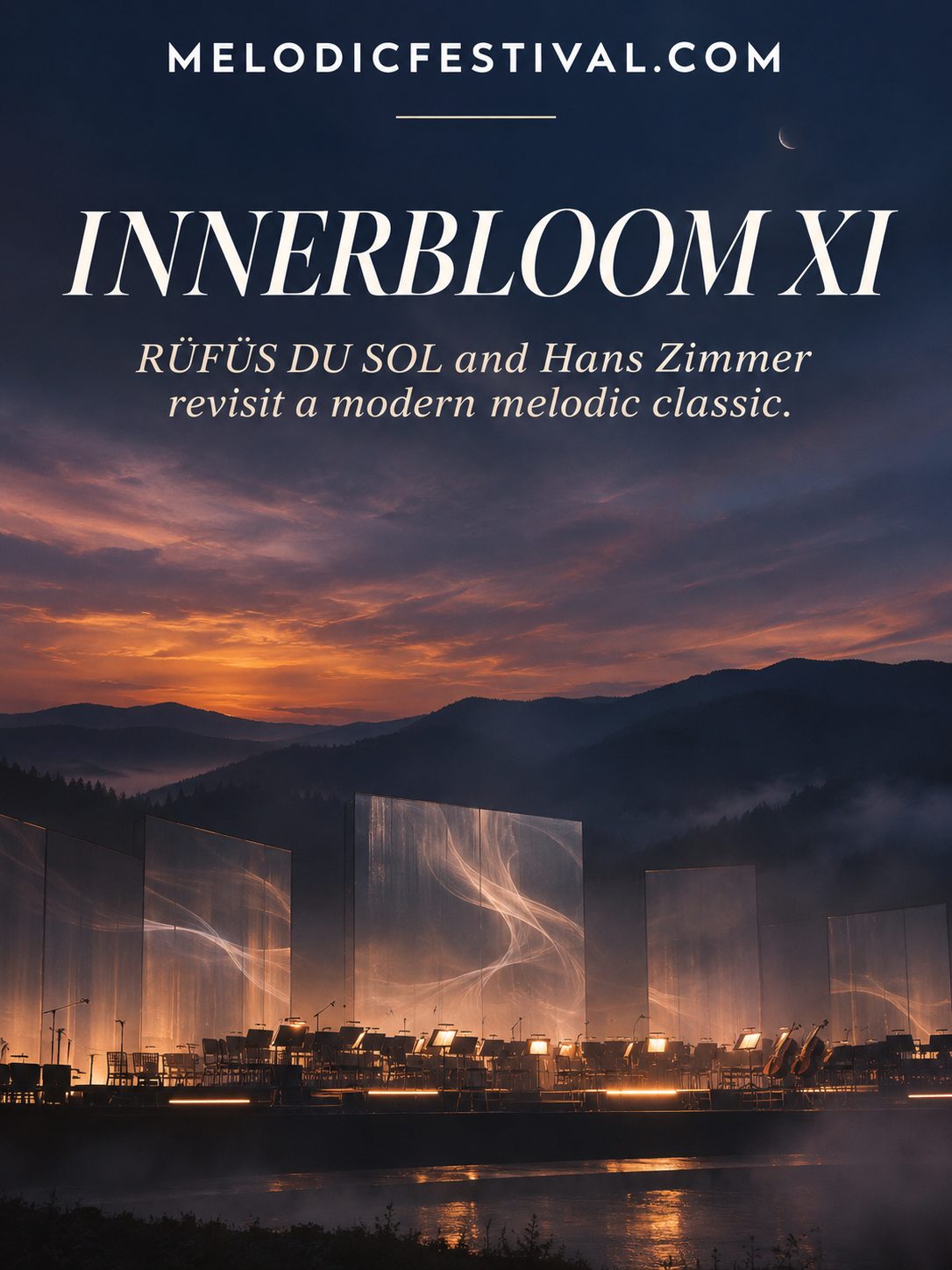
Today, exactly eleven years after the original track was released, RÜFÜS DU SOL have joined forces with legendary film composer Hans Zimmer for “Innerbloom XI”, a new reimagining of one of the most influential melodic electronic records of the last decade.
The Australian trio collaborated with Zimmer and his composer collective Bleeding Fingers, rebuilding the nine-minute journey with orchestral instrumentation while preserving the slow emotional architecture that made the original so powerful.
This is not a conventional remix.
It feels more like a translation.
Electronic emotion expressed through another musical language.
Eleven Years Since ‘Innerbloom’
The original “Innerbloom” was released on November 20, 2015, later appearing on RÜFÜS DU SOL’s second studio album Bloom.
Its length was unusual even then.
Almost nine minutes.
No rush.
No traditional pop structure designed around immediate radio impact.
The track developed slowly.
Atmosphere first.
Voice later.
Tension gradually increasing until the music finally opened completely.
The band has recalled conversations with label and radio teams about the difficulty of releasing such a long song, but they refused to shorten it because the arrangement depended on that slow development.
That decision became part of its identity.
A Song That Grew Instead of Exploding
“Innerbloom” was not initially defined by enormous chart success.
It grew through years of emotional attachment.
Live performances.
DJ sets.
Remixes.
Festival moments.
Personal memories.
The song eventually reached No. 5 in triple j’s Hottest 100 of the Decade and later No. 16 in its Hottest 100 of Australian Songs.
According to Luminate data cited by Billboard, the original has now generated around one billion official on-demand global streams.
But numbers do not really explain its longevity.
People have attached the track to weddings.
Relationships.
Breakups.
Travel.
Festivals.
Private moments.
That is harder to measure.
Hans Zimmer Enters the World of ‘Innerbloom’
Hans Zimmer is an unusually natural collaborator for this project.
His most famous work operates through exactly the same mechanism as “Innerbloom”:
slow accumulation.
A simple motif.
Repetition.
Gradual orchestration.
Emotional release.
Whether working in cinema or electronic music, the underlying idea is similar.
Do not reveal everything immediately.
Allow the listener to arrive.
For “Innerbloom XI,” Zimmer and Bleeding Fingers expand the electronic foundation through strings, percussion, xylophone, choir and additional orchestral layers.
The track remains approximately nine minutes long.
That detail matters.
They have not compressed the journey.
They have expanded the world around it.
Electronic Music Meets Film Score
The collaboration places RÜFÜS DU SOL in an interesting space.
Their music has always contained cinematic qualities.
Wide reverbs.
Long arrangements.
Emotional vocals.
Slow harmonic movement.
Large atmospheric transitions.
Zimmer brings those qualities into literal orchestration.
What previously felt cinematic now becomes cinema music.
But the electronic pulse remains underneath.
This balance prevents “Innerbloom XI” from becoming simply an orchestral cover.
Why the Original Structure Survives
One of the most powerful choices is preserving the song’s fundamental architecture.
The temptation with anniversary projects is often to modernise aggressively.
Shorten the intro.
Increase the impact.
Change the drop.
Add contemporary production tricks.
“Innerbloom XI” appears to respect the opposite idea.
The structure was already the reason the song worked.
Changing it dramatically would remove the emotional memory listeners have built around the track.
The orchestration changes.
The journey remains familiar.
Hans Zimmer Understands Repetition
Zimmer’s film scores frequently use repetition as an emotional device.
One chord progression can continue for several minutes.
One rhythmic figure slowly grows.
One motif returns in different instrumentation.
Progressive and melodic electronic music operate similarly.
The repetition is not a lack of ideas.
It creates expectation.
The listener learns the musical language.
Then even a small change becomes significant.
That is exactly what made “Innerbloom” powerful in the first place.
The Collaboration Arrives at a Symbolic Moment
The timing is deliberate.
“Innerbloom XI” arrives exactly eleven years after the original.
It is also being presented as the only official anniversary release connected with the track.
The title reflects that history.
XI.
Eleven.
The project therefore functions simultaneously as a new version and an anniversary marker.
A New Film Extends the Reinterpretation
The release is accompanied by a new visual project from longtime RÜFÜS DU SOL creative director Katzki, working with visual artist Thomás Blanchard.
The new film revisits the aesthetic language of the original “Innerbloom” video while adapting it to the new version.
That approach mirrors the music.
Do not erase the original.
Return to it.
Look again.
Reinterpret it from another point in time.
RÜFÜS DU SOL Have Always Worked Between Worlds
Part of the reason the collaboration feels natural is that RÜFÜS DU SOL have never existed entirely inside traditional club music.
They are a live band.
Electronic producers.
Songwriters.
Festival headliners.
DJs.
Their catalogue moves between House, melodic electronic music and alternative songwriting.
“Innerbloom” perhaps captures that identity better than any other record.
It can work in a club.
It can work on headphones.
It can work at a festival.
It can work almost completely outside electronic music culture.
That flexibility explains why an orchestral reinterpretation does not feel forced.
The Tour Changed the Scale Again
The band’s recent Inhale / Exhale tour became one of the largest touring achievements in contemporary electronic music.
Billboard describes the two-year global run as the biggest electronic tour of all time.
Throughout those shows, “Innerbloom” remained one of the emotional peaks of the performance.
RÜFÜS DU SOL member Jon George has described continuing to see audience members cry when the song reaches its conclusion, more than a decade after it was written.
That response explains why the track continues to be treated differently from the rest of the catalogue.
Why ‘Innerbloom’ Still Works
The song does not depend on production trends.
There is no fashionable drum pattern holding it together.
No temporary sound-design trick.
No one moment designed for a social-media clip.
Its power comes from pacing.
Melody.
Voice.
Repetition.
Emotional restraint.
Those qualities age well because they are not particularly connected to one period.
The Importance of the Nine-Minute Format
Modern electronic music increasingly moves toward shorter structures.
Streaming rewards early engagement.
Social media rewards immediate impact.
Even club tracks have often become shorter.
“Innerbloom XI” goes in the opposite direction.
Nine minutes.
Again.
That may be one of the most important choices in the entire project.
The song demands time.
A listener must enter it.
You cannot experience the full emotional arc in thirty seconds.
A Collaboration Between Two Forms of Storytelling
RÜFÜS DU SOL and Hans Zimmer work in different industries.
But they solve a similar problem.
How do you create emotional movement without words explaining everything?
Film scores do it through musical tension.
Electronic music does it through progression.
“Innerbloom XI” brings those two methods together.
The result does not need to choose between orchestra and synthesizer.
Both are simply tools for building the same emotional arc.
Eleven Years Later, the Song Is Still Growing
Many anniversary releases exist mainly because the calendar says they should.
“Innerbloom XI” feels different.
The collaboration reveals something that was already present inside the original record.
Its scale.
Its patience.
Its cinematic potential.
Zimmer does not fundamentally change what “Innerbloom” is.
He amplifies qualities the track always contained.
That is perhaps the best possible way to revisit music people already love.
Do not replace the memory.
Give it another dimension.
Eleven years after its original release, “Innerbloom” still does not feel finished.
It continues to grow.
And with Hans Zimmer now entering its world, one of electronic music’s most emotional modern records has become even larger without losing the silence, patience and vulnerability that made people fall in love with it in the first place.