
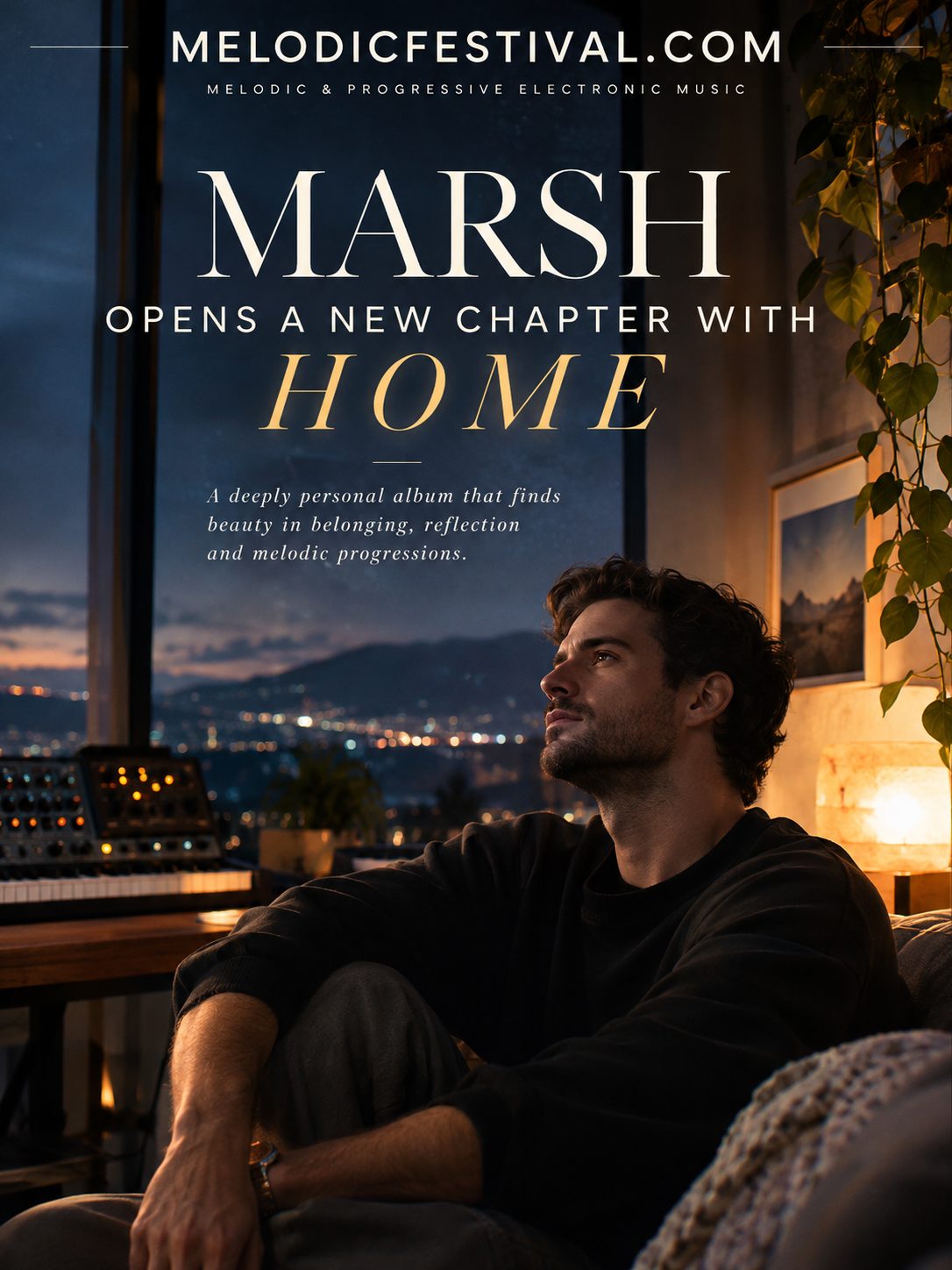
For Marsh, melody has always been about movement.
Not simply movement on a dancefloor.
Movement between memory and the present, between emotion and rhythm, between the music that shaped him and the artist he has become.
Today, November 3, that journey reaches a new chapter with Home, his fourth studio album and the first full-length project released through his own Marshan Records.
The album contains 14 tracks and features collaborations with ALLKNIGHT, Lyves, Phenoir and Leo Wood, extending Marsh’s sound beyond traditional progressive house into a wider world that includes melodic electronic music, vocal songwriting and even influences from liquid drum & bass.
For an artist whose career has become closely associated with emotional progressive music, Home feels deliberately broader.
The Meaning Behind ‘Home’
The album title is simple.
The idea behind it is not.
Marsh has spent much of the past decade travelling.
His career has taken him from intimate club rooms to international festival stages and headline performances at locations including Red Rocks and London’s Royal Naval College.
That kind of constant movement can make the concept of home complicated.
It can be a physical place.
A person.
A memory.
A feeling.
Or sometimes a sound.
Home appears to explore all of those possibilities.
Rather than treating the album as a collection of functional club tracks, Marsh uses the full-length format to create a much wider emotional landscape.
Progressive House Is Only the Starting Point
Marsh remains deeply connected to progressive house.
That foundation is still present.
Long builds.
Melodic tension.
Warm low-end.
Patient arrangements.
But Home is not limited by those conventions.
Beatportal describes the project as bringing together influences ranging from euphoric progressive house to liquid drum & bass, reflecting Marsh’s interest in early-2000s trance and more melodic forms of bass music.
That range is important.
Electronic artists often become trapped by the sound that first made them successful.
Listeners expect repetition.
Labels often encourage familiarity.
Streaming algorithms reward recognisable patterns.
Creating an independent label gives Marsh more freedom to move in the opposite direction.
Marshan Records Becomes Part of the Story
The album is also closely tied to the launch of Marshan Records.
The label debuted earlier in 2026 with the album’s title track, “Home,” before introducing additional singles including “Aloft / Too High,” “One Love” with Lyves and “Run Away” with ALLKNIGHT.
Marsh has described the imprint as a platform built around artistic freedom, emotional depth and the full range of his musical identity.
That makes the label more than a distribution mechanism.
It becomes part of the artistic statement.
By creating his own home for releases, Marsh has effectively given himself permission to move outside the boundaries listeners may associate with him.
The album title suddenly takes on another meaning.
‘Run Away’ and the Human Side of the Album
One of the clearest examples of the album’s emotional direction is “Run Away,” created with longtime collaborator ALLKNIGHT.
The track had existed as a highly requested ID since Marsh first played it at London’s Royal Naval College in 2025.
Its central idea is intimate rather than abstract: finding someone who makes the rest of the world feel temporarily irrelevant.
ALLKNIGHT’s vocal gives the track a human centre.
Marsh surrounds it with the kind of melodic progression his audience already knows, but the result is less about a dramatic club moment and more about emotional release.
That distinction matters.
Collaborations as Part of the Narrative
ALLKNIGHT is not the only voice shaping Home.
The album also includes Lyves, Phenoir and Leo Wood, allowing different vocal identities to enter Marsh’s production world.
Lyves had already appeared on “One Love,” another track introduced ahead of the full album.
Leo Wood also has a history with Marsh, having previously featured on music from his earlier catalogue.
These collaborations help give the album continuity.
The voices change.
The emotional language remains connected.
A Career Built Around Emotional Electronic Music
Marsh has spent years refining a sound that sits somewhere between progressive house, trance influence and deeper melodic electronic music.
His earlier albums, including Lailonie and Endless, helped establish that identity.
Lailonie, released in 2020, was written partly around themes of healing and loss and became one of the projects that defined Marsh’s reputation for emotionally rich production.
Endless expanded that world further.
Now Home appears to move beyond it.
Not by rejecting the past.
By opening the structure around it.
Melody Without Genre Walls
This may be the most interesting aspect of the album.
Marsh’s music has always relied on melody.
But melody is not a genre.
It can exist inside progressive house.
Trance.
Ambient music.
Drum & bass.
A vocal record.
A club track.
By allowing Home to move between those spaces, Marsh is making a larger point about his identity.
The emotional core matters more than the category around it.
That idea feels particularly relevant in 2026, when electronic genres are increasingly overlapping.
Progressive house artists play melodic techno.
Trance influences appear inside house records.
Drum & bass textures move into melodic electronic albums.
The boundaries are still visible.
But they are less important than they once were.
A New Stage for Marsh
The release of Home also arrives with a major live moment approaching.
Marsh is scheduled to present a headline album show at London’s Roundhouse on November 13, with collaborators including ALLKNIGHT, Lyves and Leo Wood expected to join him.
That performance should reveal another side of the project.
An album can create a world in headphones.
A live show has to translate that world into a shared space.
For music built around emotional progression, that transformation can be especially powerful.
Finding Home Through Sound
Marsh has spent years becoming one of the most recognisable names in melodic and progressive electronic music.
That success could easily have encouraged him to refine the same formula indefinitely.
Instead, Home suggests an artist trying to widen the frame.
Fourteen tracks.
Several collaborators.
Different tempos.
Different genres.
One emotional centre.
Perhaps that is what the title ultimately represents.
Home is not necessarily where the music stays the same.
It is where the artist feels free enough to change.