
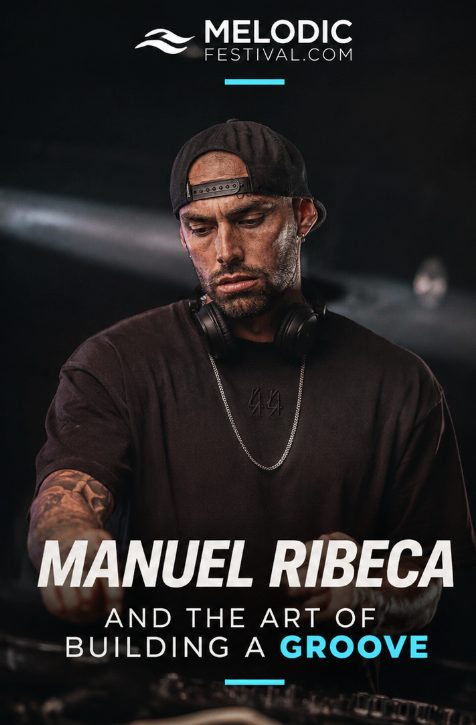
Before Ibiza, before international tours and before the releases, there was a dancefloor in Perugia.
For Manuel Ribeca, the path into electronic music began at Red Zone Club, one of the most important venues in the history of House music in central Italy.
He was 17 when the club became part of his weekly routine.
Every Saturday, Ribeca listened.
House.
Electronic music.
International DJs.
Different ways of building a night.
Years later, he would describe that period as an education. Red Zone was not simply where he discovered club music. It was where he began to understand what a DJ could do to a room.
That experience still explains much of the music he makes today.
Learning Before Playing
There is something important about developing as a DJ from the dancefloor first.
Before learning how to control the energy, you experience what that energy feels like from the other side of the booth.
Ribeca spent years absorbing that relationship.
Alongside Red Zone, visits to Riccione exposed him to Italian House figures including Ricky Montanari, Flavio Vecchi, Massimino Lippoli, Ricky L and Sauro Cosimetti.
These were artists from a generation in which the DJ set was often built slowly.
Records were not necessarily selected because they contained the biggest drop.
They were chosen because of what they could do to the next record.
That approach is still audible in Ribeca’s work.
His current music may be Tech House and Minimal, but the foundation remains House.
Groove comes first.
Ibiza as a Second School
If Red Zone was the first education, Ibiza became the second.
Ribeca moved to the island in 2016, describing the decision as one of the most important steps in his artistic development. Being surrounded by leading DJs, promoters and club culture changed the way he thought about his career and forced him to become more precise in the studio.
The relationship has lasted.
Across the years, Ribeca has played in environments including Hï Ibiza, Amnesia, Club Chinois, Cova Santa, Bora Bora, Privilege and Tantra.
But one performance appears to have remained especially important.
Asked about his best DJ set, Ribeca chose his warm-up for Joseph Capriati at Tantra Ibiza.
That answer is revealing.
A warm-up is about control.
It is about resisting the temptation to play too much too soon.
The DJ has to understand tension, timing and what the artist playing next will need from the room.
Those are the same qualities that define a strong groove-driven production.
Tech House Without Losing the House
Today, Ribeca’s music is generally described through Tech House and Minimal.
His tracks rely heavily on percussion.
Basslines roll rather than explode.
Vocals are often used rhythmically.
The arrangement is designed to create repetition without becoming static.
But the House influence has never disappeared.
That is what separates groove-oriented Tech House from tracks built only around impact.
There has to be swing.
There has to be space.
The relationship between kick, percussion and bass needs to create movement before any larger production element arrives.
Ribeca seems particularly interested in that space.
‘Traigo Mi Flow’
His 2026 track “Traigo Mi Flow”, released through Motel Calypso, provides a useful example.
The production is based around hypnotic percussion, warm bass pressure and a vocal filtered through robotic textures.
Nothing is unnecessarily complex.
The track works by repeating a limited number of elements while constantly changing the way they interact.
That is one of the hardest things to achieve in club music.
Repetition has to become hypnotic without becoming predictable.
The difference is often found in extremely small details.
A percussion sound appearing half a bar earlier.
A vocal disappearing.
A bassline opening slightly.
A breakdown lasting four bars longer than expected.
The listener may not consciously notice these choices.
The dancefloor does.
‘Bus Down’ and a More Percussive Direction
The Bus Down EP, created with Australian artist Sohail and released on Clarisse Records, explored a more explosive version of the same idea.
Samba-influenced drums, rattling percussion, heavy kick drums and vocal samples gave the project a stronger festival character without removing the groove underneath.
The EP demonstrated Ribeca’s ability to increase energy without abandoning his basic production language.
The records remain rhythmic.
The bass remains central.
The tracks still feel built for mixing rather than simply streaming.
A Growing Catalogue
Ribeca’s recent catalogue has become increasingly wide.
In 2026 alone, releases have appeared through Ibiza Talents Records, Delicious Recordings, Witty Tunes, Clarisse Records, La Pera Records, NONSTOP, Techaway Records and AS ONE.
Collaborations have also become central to his output.
Sohail.
Notwins.
Blow.
LoreFox.
Jean Casas.
Andrea Serra.
DAN.
Each collaboration places his groove inside a slightly different context.
Earlier releases also connected him with Sola Records and Baikonur, while his productions have received support from artists including Jamie Jones, Ilario Alicante, Cloonee, Fisher, Chris Lake, Meduza and Marco Carola.
Between Minimal and More Immediate Energy
One of the interesting things about Ribeca is that his sound does not sit entirely on one side of the underground-commercial divide.
There are minimal influences.
There are stripped-back arrangements.
There is an obvious interest in groove.
But many of the records also contain vocal hooks and rhythmic ideas capable of working with larger crowds.
This balance reflects the places where he has played.
A DJ who moves between smaller club rooms, Ibiza venues and international events needs records that can adapt without losing their identity.
Ribeca’s music often seems built with exactly that flexibility in mind.
The Influence of Hip-Hop
There is another element beneath the House foundation.
Ribeca has spoken about his hip-hop influences, even identifying an original Roland TR-808 as one of the pieces of equipment he would most like to add to his studio.
That influence may help explain his frequent use of vocal fragments, rap-inspired samples and rhythm-first production.
Tech House and hip-hop may appear distant as genres, but they share something important.
Both can depend heavily on groove.
The way a vocal sits against a beat can matter more than the melody around it.
For a producer like Ribeca, that relationship creates another layer inside his club music.
Beyond Europe
2026 has also widened his geographical perspective.
Ribeca began the year with his first Asian tour, travelling through Thailand and Bali while continuing an active schedule in Italy. He described the experience as a way of encountering new environments and cultures while preserving the same core musical identity.
That idea is significant.
The strongest club music can travel because rhythm does not need translation.
A groove that works in Perugia can work in Ibiza.
A record tested in Amsterdam can work in Bali.
The environment changes.
The reaction can remain surprisingly similar.
More Than Fifteen Years Inside the Club
Manuel Ribeca has now spent more than fifteen years developing across different sides of club culture.
DJ.
Producer.
Showcase organiser.
Ibiza resident.
International touring artist.
But the central idea remains almost unchanged from those first Saturdays at Red Zone.
A dancefloor is a conversation.
The DJ introduces something.
The crowd answers.
The next record changes because of that response.
Ribeca’s music increasingly reflects that philosophy.
It does not try to tell the listener everything immediately.
It builds.
Repeats.
Moves.
Waits.
Then pushes again.
And perhaps that is the clearest connection between the teenager listening from the floor in Perugia and the producer releasing Tech House internationally today.
The tools changed.
The groove did not.